|
Useful information on travel to
Cochin, also featuring a travel guide on Cochin. |
![]() ![]() ![]() |
|
Kerala Spielraum - Kerala Indien -
Kerala Tourismus - Recorrido De
Kerala - Turismo De Kerala -
Voyage Du Kerala - Le Kerala Inde - Tourisme
Du Kerala |
COCHIN
: Queen of the Arabian SeaUndoubtedly the commercial hub of Kerala, the city of Cochin is where ancient civilization gracefully mingles with modern life. Right from the early years, Cochin has had cultural and trade relations with the outside world. She had also experienced pulsating episodes of European colonial rivalry. An interesting point to note is that Cochin is probably the only city in India formed from parts of three different states, viz. the two princely states of Travancore and Cochin, and the British Malabar. In 1976, the village panchayats of Edappally, Vennala, Vyttila, and Palluruthy were merged with the municipalities of Ernakulam and Mattancherry to form the Corporation of Cochin. Today with a natural, all-weather harbour and replete with serene backwaters, beautiful lagoons, wooded isles, and a magnificent seascape, Cochin is indeed the Queen of the Arabian Sea. TOURIST ATTRACTIONS MATTANCHERY PALACE Mattanchery Palace is situated at Mattanchery about 10 kms from Jos Junction the centre of the City. Mattanchery has been an important trading center for the past few centuries. The town has a mixed population consisting of Hindus, Jews, Muslims, Christians and other communities. The Mattanchery Palace known popularly as the Dutch Palace was built by the Portuguese in 1555 and later remodeled by the Dutch. The Palace is one of the oldest buildings of the Portuguese and is in Oriental style. It is quite unique from historical & architectural point of view. It was built by the Portuguese and presented to Veera Kerala Varma in order to pacify him and to compensate for having plundered a temple in the vicinity of the Palace. It has served as a seat of the Royal House and important functions connected with the coronation of the Maharaja used to be held here. It was during AD 1665 that major repairs and renovation was carried but by the Dutch. The Palace is a two tiered quadrangular building consisting of long spacious halls with a central courtyard enshining the Royal deity, Palayannur Bhagavati. Two more temples are situated on either side of the Palace dedicated to Lord Krishna & Lord Siva respectively. The ground floor known as the Ladies Chamber is connected by a staircase from kanithalam room.. The upper storey consists of Coronation hall, Bed Chamber, Dining Hall, Assembly Hall and the Staircase room The eastern portion of the coronation hall is square and is meant for the coronation ceremony of the Kings and the Western portion is meant for other distinguished members. The ceiling is decorated with inverted lotus (Adhopadma) and other floral designs representing the finest wooden carvings of the period. A perpetual light (Kedavilakku) is kept in the Royal bed chamber (Palliyarai) as a mark of respect to one of the Cochin Maharajas who died here. Here we can see one of the finest and perhaps oldest murals of Kerala depicting Ramayana story The ceiling of Dining Hall is fitted with a large number of brass cups whereas the ceiling of Assembly Hall is more ornamental. St.
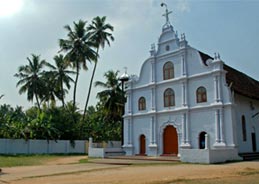
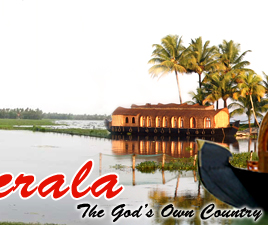
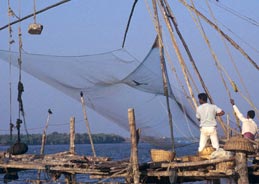
FRANCIS CHURCHSt. Francis Church is considered to be India's oldest European Church. This Protestant church was built originally by the Portuguese in AD 1510. The Church covers the site of St. Bartholomews, a wooden structure built by the five frairs who accompanied Albuquerque to Cochin in 1503. The Portuguese Viceroy Almedia was permitted by the Cochin Raja in AD 1506 to reconstruct the building in stone masonary. The medicant order of Franciscane raised the present building and dedicated it to St. Anthony. Vasco da Gama, the great navigator, soldier and statesman, was buried here in 1524 before his remains were returned to Portugal 14 years later in 1540. During 1510 to 1663 this church was officially called the conventional church of the order of St. Francis of Assissi by the Portuguese. The Dutch made some changes in the name and structure of the Church in AD 1779. It was known as the Government Protestant Church from 1819-46 and it was only after the restoration work carried out by the English that this edifice became known as St. Francis Church BOLGHATTY PALACE Bolghatty Palace was built by the Dutch on the Southern Extremity of the Bolghatty Island just across the High Court Jetty. One of the attractions is the mini golf course in the Palace grounds. There are several vantage points for lovely views of the harbour and the sea. The Palace was built by the Dutch in the year AD 1744. It used to be the seat of the British Resident, but is now used as a Tourist Bunglow by the Kerala Tourism Development Corporation. The Bunglow is two storeyed and contains well decorated bed chambers, a huge lounge wherein historical portraits are displayed. HILL PALACE MUSEUM The Hill Palace Museum is situated about 16 kms east of Cochin city on the Ernakulam-Piravam Road. The Palace complex shows a synthesis of European and Kerala styles of architecture. The Palace is a good example of classical architecture and the major attractions are Nalukettu (four sided building with a central courtyard), a few agraharams, an imposing bunglow built in Dutch style and a royal durbar. This sprawling Palace, built by the Dutch and presented to Sakthan Thamburan, the then Raja of Cochin, now houses a museum. The museum mainly displays the erstwhile wealth and prosperity of the royal family of Cochin, inlcuding the King's throne and crown. The antiquities displayed also include coins, palanquins, palm leaf manuscripts, wooden sculptures, paintings etc. The museum has a fairly good collection of antique temple carvings. There is a deer park in the Palace compound. CHINESE FISHING NETS Chinese fishing nets are a legacy of the earlier visitors to the Malabar Coast. The entrance to the Cochin Harbour is dotted by these fishing nets called "Cheena Vala" in malayalam. The records show that these fishing nets were first erected between AD 1350 and 1450. These are large nets, which hang from bamboo or teak posts with lights suspended above the net. These nets also have counterweights in order to facilitate easy-handling of the nets. The local fishermen still use these nets to catch the fish attracted by the light suspended above the nets. Nowadays these nets have become more of a tourist attraction. The best place to watch is from Vasco Da Gama Square, a narrow promenade that parallel the beach with little stalls serving varied kinds of sea food. Silhouetted against the sunset, they present a spectacular sight of Cochin's waterfront. MARINE DRIVE Marine Drive is considered to be one of the most beautiful parts of the city. It is also called as Shanmugham Road. The marine walk is the main hangout for the local populace as the view of the backwaters and the harbour from here is excellent. At night the lights from the various ships anchored at the harbour is just breathtaking. There are various buildings along the Marine Drive which are good examples of modem architecture with the notable one being Asoka Apartments on the southern end of the Marine Drive with a huge Namaste, the traditional greeting. The GCDA complex at the Marine Drive houses many of the important showrooms and eating joints. KODER HOUSE Koder House was built in 1808 by Samuel S Koder of The Cochin Electric Company. It is a building with its red coloured brick-like façade representing the transition from the colonial to the Indo-European period. Unique features of the building includes floor tiles in chess board pattern, wood carved furniture and a wooden bridge running parallel over Rose lane onto a separate structure across the street. SANTA CRUZ BASILICA The Santa Cruz Basilica was built by the Portuguese and was later elevated to a Cathedral by the Pope Paul IV in 1558. It escaped the destruction by the Dutch conqueror in 1663 but was later demolished by the British when they took over Cochin in 1795. There was no church on the site for almost 100 years until Bishop Dom Gomez Vereira commissioned a new building in 1887. It was consecrated in 1905, Santa Cruz was proclaimed a Basilica by the Pope John Paul II in 1984. JEWISH SYNAGOGUE The synagogue is situated next to the Mattanchery Palace and is an important historical monument. The synagogue also known as "Paradesi Synagogue" was built in AD 1567. Later in AD 1664 it was rebuilt by the Dutch. The synagogue is also important in view of the fact that it houses the famous copper plate grant of Bhaskara Ravi Varma dated AD 1000, a golden crown presented by the Maharaja of Travancore in AD 1805 and the great scrolls of the old Testament. There are nearly two hundred and fifty six blue and white willow-pattern tiles, now forming the payment which were brought from Canton in China. These tiles were presented to the synagogue by Mr. Ezekeil Rahabi, a rich merchant who also built a clock tower. The scene depicted on each of these two hundred year old tile is different from the other and no two tiles are alike. COCHIN BOAT RIDES The Cochin Boat rides allow you to soak in the real beauty of Cochin which lies in its backwaters extending east and south from the harbour dotted with tiny islands formed naturally by alluvial deposits from the rivers. The most beautiful of all the islands is Bolghatty built by the Dutch. The sunset with the Chinese fishing nets in the background can be seen while you enjoy your boat-ride. WILLINGDON ISLAND It is one of Cochin's famous islands named after Lord Willingdon, the British Viceroy of India. This is a man-made island created in 1920's by the British using the material dredged while constructing and deepening of the Cochin Port. It is situated between Ernakulam and Mattanchery separated by the backwaters. Willingdon island is now an important part of Cochin with many of the important hotels, Government Offices, Shipping companies, Cochin Port Trust etc. located here. |
|
|
Copyright ©
Kerala
Tourism.org |